By Rachel Bennett
You love your partner. That’s not the problem. The problem is that being in the relationship feels like work. Not the good kind of work, the kind where you build something together. The exhausting kind. The kind where you’re constantly managing, monitoring, adjusting, translating, and performing closeness instead of just feeling it.
Texting back at the right speed. Checking in at the right frequency. Choosing your words carefully during every difficult moment. Making sure you’re being emotionally available enough, communicative enough, present enough. You didn’t sign up for an emotional operations role, but that’s what the relationship has become. And the worst part is that you can’t explain this to anyone without sounding like you don’t love the person. You do. You’re just tired.
This is relationship burnout. And it’s becoming the default experience for a generation of couples who were taught to prioritize communication, emotional intelligence, and constant processing, but were never taught when to stop.
The Real Problem Is Not Conflict. It’s Constant Maintenance.
Most relationships don’t collapse because of a single betrayal or one explosive fight. They erode through the weight of daily emotional maintenance. The conversations about the conversation. The processing of the processing. The constant calibration of “are we okay?” that turns love into a project instead of a connection.
It looks like this: repetitive check-ins that feel obligatory rather than genuine. Small misunderstandings that become hour-long discussions. One partner carrying the bulk of the emotional labor while the other drifts into passivity. A persistent background hum of tension that never quite becomes a fight but never quite goes away.
Both people might still love each other deeply. But they’re exhausted by the effort of maintaining the relationship at the standard they think it requires. And that exhaustion is what makes love start to feel like work.
When the Emotional Load Is Lopsided, Resentment Fills the Gap
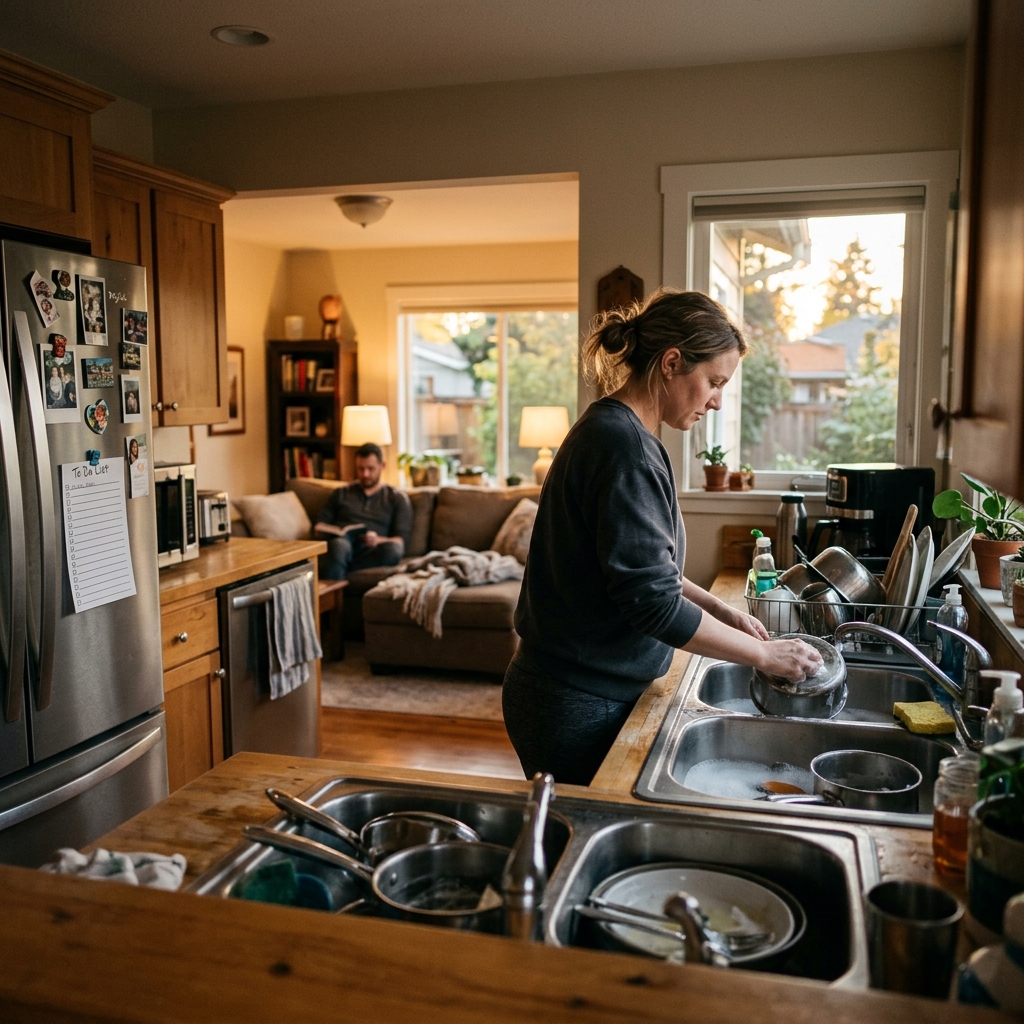
In most relationships where love feels like a job, one person has become the emotional project manager. They’re the one initiating hard conversations, noticing distance, managing the temperature of the relationship, and making sure things don’t fall apart. The other person isn’t necessarily selfish or checked out. They might simply not realize how much invisible work is being done.
Over time, this imbalance builds resentment that’s almost impossible to articulate without sounding accusatory. “You never initiate.” “I’m always the one who has to fix things.” “I’m doing all the emotional work.” These statements are usually true, but they’re also loaded, and they tend to start fights instead of solutions.
The resentment doesn’t come from the work itself. It comes from the imbalance. If both people were sharing the load, the work would feel like partnership. When one person carries it alone, it feels like a second job.
Performing Connection Is Not the Same as Feeling It
Modern relationship culture has created an expectation of constant emotional performance. Always communicate perfectly. Always be emotionally available. Always process your feelings in real time. Always do the “healthy” thing.
This sounds good in a therapy session. In daily life, it’s suffocating. Perfect communication every single day is not what love looks like. It’s what performance looks like. And when you’re performing closeness instead of experiencing it, the relationship starts to feel hollow even when nothing is technically wrong.
Real intimacy includes silence that isn’t tense. It includes being in the same room without talking and feeling fine about it. It includes letting a small thing go without turning it into a growth opportunity. The couples who last are the ones who figured out the difference between showing up and performing. For a practical framework on how to communicate better in less time, see 5 minute conversation framework ends arguing.
What Actually Helps
If your relationship feels like a second job, the fix is not more communication. It’s smarter communication, less of it, with better boundaries around when and how you process things.
First: stop processing everything in real time. Most small frustrations don’t need a conversation. They need a night of sleep. If the irritation is still there in the morning, then talk about it. If it’s gone, it was a mood, not a problem. Treating every mood as a problem is what’s exhausting both of you.
Second: divide the emotional labor explicitly. This feels unromantic, but it works. “You plan date night this month, I’ll plan next month.” “You bring up the thing you’ve been noticing, and I’ll bring up mine, and we’ll spend 15 minutes on both.” When the labor is visible and shared, the resentment dissolves.
Third: protect unstructured time together. Time where you’re not processing, not improving, not fixing anything. Watching a show. Cooking without talking about your relationship. Going for a drive. The relationship needs time where it doesn’t feel like a relationship project. It needs time where it just gets to be two people existing together.

When Love Stops Feeling Like Work
Love stops feeling like a job when you stop treating it like one. When you trust that not every uncomfortable moment needs to be processed right now. When you share the emotional weight instead of letting one person carry it alone. When you remember that connection doesn’t require constant maintenance, it requires presence, honesty, and the occasional willingness to let things be imperfect. For a broader look at how burnout shows up in every area of life, not just relationships, see burnout costing 47000 year reverse 30 days.
The couples who make it aren’t the ones who communicate perfectly. They’re the ones who know when to talk, when to rest, and when to just sit together without saying anything at all.
Your Move This Week
Pick one evening this week where you and your partner are together with no agenda. No check-in. No processing. No “we need to talk.” Just exist together. Cook something. Watch something. Go for a walk. Let the relationship breathe. If that sounds impossible, that’s your signal that this article was written for you. Tell me in the comments what you did with that evening, or share this with the partner you think needs to read it.