Skip to content
BrainHub
A phone timer set to 10 minutes sits on a desk next to an open laptop, representing the 10-minute pattern interrupt for beating procrastination.

The Procrastination Lie You Keep Telling Yourself (And the 10-Minute Pattern Interrupt That Kills It)

Personal Development & Self-Improvement

By Lauren Mitchell You know the feeling. The thing you’re supposed to be doing is right there. You’ve known about it for days, maybe weeks. You’ve told yourself you’ll “do it when I have more time,” “do it when I’m in the right headspace,” “do it after I finish this other thing first.” And somehow the day ends, and you didn’t do it, and you tell yourself tomorrow will be different. Here’s the lie you’re telling yourself. The lie is that you’re waiting for the right moment, the right energy, or the right mood. You’re not. You’re waiting for something else. And until you see what you’re actually waiting for, no productivity app, time-blocking technique, or morning routine will fix the problem. Procrastination isn’t about time. It’s about what you feel when you try to start. The Lie: “I’ll Do It When I Feel Ready” When you say “I’ll do it when I feel ready,” you’re outsourcing the start to a feeling that isn’t coming. The feeling you’re waiting for, confidence, clarity, motivation, calm, doesn’t show up before the work. It shows up during the work, and only sometimes. Most of the time, it doesn’t show up at all, and the work still gets done by people who stopped waiting. You are not lazy. You are not broken. You are stuck in a loop where your brain has decided the task is emotionally threatening, and starting it feels like walking toward something painful. That’s why you find every other possible thing to do. Not because the other things are important. Because they offer emotional relief. The browsing is relief. The email-checking is relief. The organizing your desk is relief. None of it is actually procrastination in the lazy sense. It’s avoidance of something you haven’t named yet. What You’re Actually Avoiding Procrastination almost always traces back to one of three emotional triggers. Pull on yours, and the stuckness starts to loosen. First: fear of judgment. You’re not avoiding the task. You’re avoiding the feeling of producing something someone might criticize, dismiss, or ignore. The task becomes loaded with every previous time you felt rejected or not good enough, and starting it means exposing yourself to that possibility again. Second: fear of commitment. Starting the task means committing to it, and some part of you isn’t sure you want to. Maybe you don’t actually want this job, this project, this relationship, and the procrastination is your body refusing to move toward something it doesn’t want. The question isn’t “why am I procrastinating?” It’s “do I actually want this?” Third: overwhelm. The task looks too big. You can’t see the first step. The moment you think about starting, your brain sees the mountain and freezes. You’re not avoiding the task. You’re avoiding the feeling of facing something you don’t think you can handle. For a deeper look at what happens when your nervous system gets stuck in that freeze response, see youre not lazy youre trapped. The 10-Minute Pattern Interrupt Now the fix. This is the single most effective technique for breaking procrastination I’ve ever found, and it works whether you’re dealing with fear, overwhelm, or just the low-grade resistance that sits on most tasks you don’t want to do. It takes ten minutes. No apps. No willpower. No morning routine required. You commit to doing the thing for ten minutes. That’s it. Ten minutes. You can stop when the timer goes off with no guilt. You can walk away. You can declare yourself done. The only rule is that for those ten minutes, you do the thing you’ve been avoiding, and nothing else. Why 10 Minutes Works When Hours Don’t The brain’s resistance is almost entirely to the size of the commitment, not the task itself. When you tell yourself you have to write for two hours, your brain calculates the cost and says no. When you tell yourself you have to work out for 45 minutes, same result. The number is too big. The prospect of sustained effort triggers the freeze. Ten minutes is small enough that the brain doesn’t protest. You can do anything for ten minutes. Even something you hate. So the commitment lands, the timer starts, and you begin. And here’s the secret: roughly 80 percent of the time, once you’ve been doing the task for ten minutes, you keep going. The resistance was never about the task. It was about the size of the commitment. Once you’re in, you’re in. How to Run the 10-Minute Interrupt in Real Life Set a timer. Physical timer, phone timer, whatever you have. Announce to yourself out loud: “I’m going to work on this for ten minutes. Then I can stop.” Start. No scrolling, no checking email, no looking at your phone, no letting yourself drift. Just the task. When the timer goes off, you get to make a real choice. Stop without guilt, or keep going. Most of the time, you’ll keep going, because you’re already past the resistance and into the work. If you stop, that’s fine. You just did ten minutes you wouldn’t have done otherwise, and you proved to your brain that starting this task isn’t the catastrophe it was making it out to be. The Repetition That Rewires the Pattern The 10-Minute Rule works once. But it works permanently if you run it enough times. Every time you do it, your brain registers one more piece of evidence that “starting this task is survivable.” After the first dozen times, the resistance starts to soften. After the first few months, it barely shows up. You’ve rewired the pattern that was keeping you stuck. This is the difference between a productivity trick and a long-term behavior change. Most productivity tricks work for a week and fade. The 10-Minute Rule doesn’t fade because you’re not relying on willpower. You’re building a track record. And every time you honor the ten minutes, you reinforce your identity as someone who follows through, even when you don’t feel like it.

May 2, 2026 / 0 Comments
read more
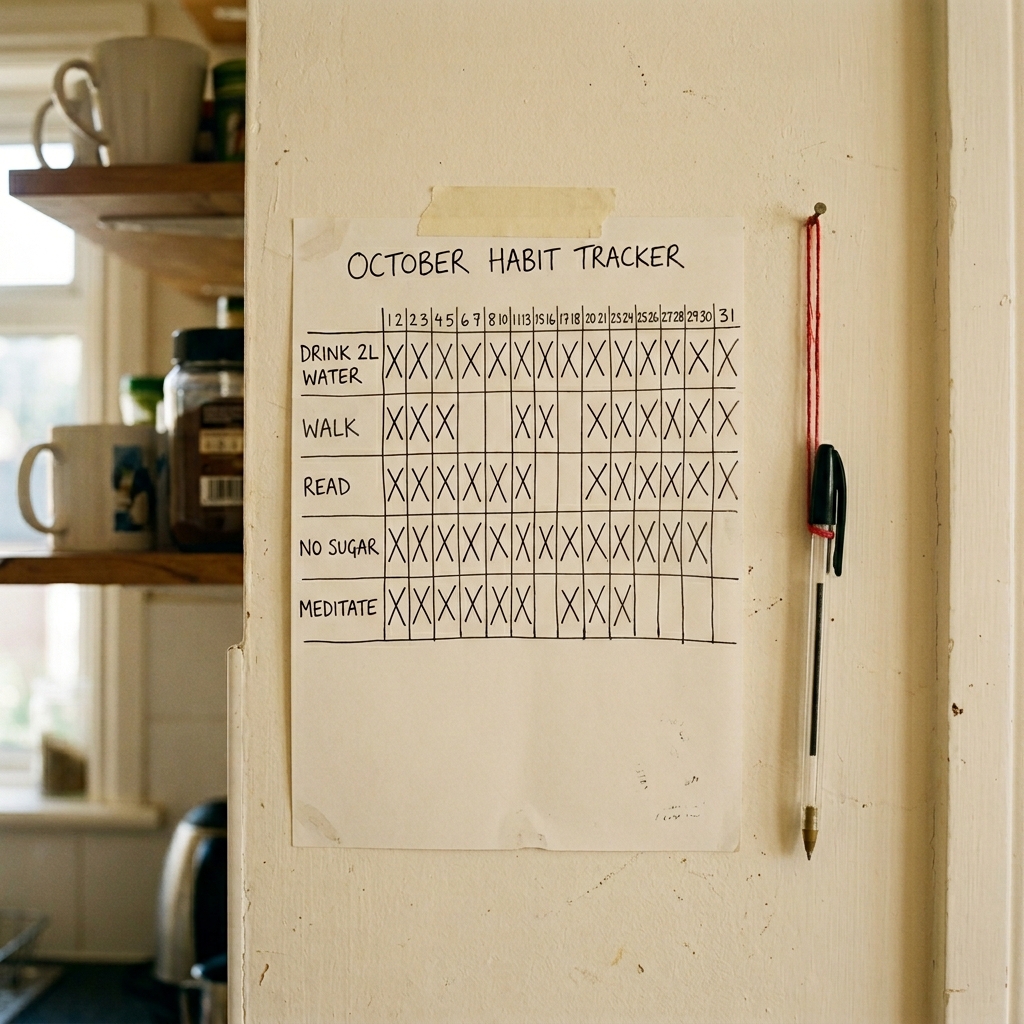
A simple habit tracker calendar on a wall with checkmarks on most days, representing the boring consistency system that replaces motivation.

Motivation Is Dead. Here’s the Ugly, Boring System That Actually Keeps You Consistent When You Feel Nothing

Personal Development & Self-Improvement

By Rachel Bennett There’s a reason motivation videos get millions of views and almost nobody’s life changes after watching them. Motivation isn’t a strategy. It’s a weather pattern. Some mornings you wake up feeling electric, ready to attack the day. Most mornings you don’t. And the gap between the 10 percent of days you feel motivated and the 90 percent you don’t is where most goals quietly die. The people you envy (the ones who actually finish the book, build the business, lose the weight, learn the language) do not have more motivation than you. They have less. They’ve given up on motivation entirely. What they have instead is a system so boring, so small, and so repetitive that it works whether they feel like it or not. Here’s the ugly truth about how consistency actually works, and the system that replaces motivation once you stop waiting for it. Motivation Was Never Supposed to Be the Engine The fitness industry sold you a lie. The self-help industry extended it. Every social media guru built their brand around it. The lie is: “feel the motivation, then do the work.” In reality, the sequence is reversed. You do the work first. Motivation shows up afterward, if at all. And most days it doesn’t show up, and the work still gets done. Every elite performer in every field describes the same thing when you read their interviews closely. They don’t feel motivated most days. They feel the same lukewarm reluctance you feel. The difference is they stopped waiting for the feeling to arrive before they got started. They decoupled the action from the emotion. The System: Shrink the Entry Point Until Resistance Disappears Most consistency failures happen at the start. You don’t fail to write the novel. You fail to open the document. You don’t fail at working out. You fail to put on the shoes. The battle is won or lost in the first 60 seconds of whatever you’re trying to do, and motivation is the worst possible tool for winning that battle. So you shrink the entry point. Instead of “write for an hour,” the commitment is “open the document.” Instead of “do a full workout,” the commitment is “put on the clothes.” Instead of “meditate for twenty minutes,” the commitment is “sit down and close your eyes for three breaths.” This sounds too small to matter. It is not. The shrunken entry point bypasses the nervous system resistance that was blocking the larger action. Once you’re in the document, you usually keep typing. Once the workout clothes are on, you usually train. The small action does the heavy lifting the motivation was supposed to do. Attach the Habit to Something You Already Do The second pillar of the boring system is something behavior researchers call “habit stacking.” Instead of relying on memory or intention to trigger a new habit, you attach it to an existing one. After I pour my morning coffee, I open the document. After I brush my teeth at night, I write one sentence in my journal. After I sit down at my desk, I write one line of the book. The old habit becomes the alarm clock for the new one. For more on how environment design beats willpower, see youre not lazy youre trapped. This removes the moment-of-decision that kills most new habits. You’re no longer deciding every morning whether to work on the book. The coffee makes the decision for you. The brushing makes the decision for you. By removing the decision, you remove the failure point. Never Miss Twice The most honest truth about consistency is that everyone misses days. You will miss workouts. You will miss writing sessions. You will miss the morning routine. The difference between the consistent people and the inconsistent ones is not that the consistent ones never miss. It’s that they have a hard rule about missing: never two days in a row. Miss one day, and it’s a rest day. Miss two days in a row, and that’s the beginning of a new default. Three days becomes a week. A week becomes a month. The consistent person protects the second day at all costs. They don’t need to be perfect, but they treat two-day gaps as the red line that triggers immediate action, even if the action is the minimum version. Track It So You Can’t Lie to Yourself You will lie to yourself about how often you do the thing. You’ll remember the good weeks and forget the bad ones. You’ll tell yourself you’re doing great when you’ve missed half the days. The only cure is to track it in a way you can’t manipulate. A simple calendar with an X on each day you did the thing is enough. A spreadsheet works. A paper habit tracker taped to the fridge works. The specific tool doesn’t matter. What matters is that the evidence is visible, honest, and impossible to ignore. Seeing the gaps in your tracker is uncomfortable. That discomfort is the feedback loop that keeps you consistent. Detach Identity From Outcomes, Attach It to Actions Here’s the mindset shift that makes the whole system stick. Stop defining yourself by what you’ve accomplished, and start defining yourself by what you do every day. I’m not a person who “will write a book.” I’m a person who writes every morning. I’m not a person “trying to get in shape.” I’m a person who trains three times a week. The outcome stops being the carrot. The identity becomes the reward. You get to be that person every single day you do the thing, regardless of whether the outcome has arrived yet. For more on how perfectionism disguises itself as high standards, see procrastination lie you keep telling yourself. This is why consistent people seem unfazed by slow progress. They aren’t chasing the outcome. They’re already living as the person who takes the action. The outcome is a downstream consequence of who they’ve decided to be, and who

May 2, 2026 / 0 Comments
read more
An entrepreneur sits at a clean, organized desk with a closed laptop and a notebook, symbolizing a fresh discipline reset and intentional focus.

The 7-Day Discipline Reset: How Burned-Out Entrepreneurs Rewire Their Focus Before the Business Suffers

Personal Development & Self-Improvement

By Lauren Mitchell There’s a specific moment most entrepreneurs recognize. You sit down at your desk, open your laptop, and realize you’ve lost something. The fire. The edge. The ability to just sit and execute. You spend thirty minutes clicking between tabs. You answer three emails. You check Slack. You check it again. The day is gone and nothing real got done. This is the first visible sign of discipline erosion. It isn’t laziness, and it isn’t a character flaw. It’s a system that’s been running too hard for too long, and the work that used to come easily now requires six times the mental force to start. If you don’t reset it quickly, the erosion spreads. It starts showing up in missed calls, skipped workouts, declined invitations, and eventually in the numbers of the business itself. The good news is that discipline is not a trait. It’s a system. And systems can be reset in seven days if you know which levers to pull. Here’s the exact protocol. Day 1: Stop Lying to Yourself About Your Sleep Most burned-out entrepreneurs are running on bad sleep they’ve normalized. Six hours a night is not enough. Five hours a night is a crisis. Before you fix your calendar, your focus, or your habits, you have to stop negotiating with sleep. On Day 1, set a non-negotiable bedtime that gives you seven and a half hours before your wake time. Put your phone outside the bedroom. Cut caffeine after noon. If you wake up feeling foggy for the first few mornings, that’s sleep debt catching up, not a problem. Keep going. For more on what happens when you’re sleeping but not rested, see 8 hours sleep still tired hidden energy thief. Day 2: Audit Your Calendar Without Mercy Most discipline problems are actually calendar problems. You’re not undisciplined. You’re overcommitted. Every hour of your day is claimed by meetings, slack messages, fires, and favors, and the actual work of your business gets the leftovers. Open your calendar. Look at the last seven days. For every meeting, ask one question: “Did I have to be there?” For every recurring meeting, ask: “If this were cancelled, what would actually go wrong?” In most cases, the answer is “not much.” Cut ruthlessly. Block two uninterrupted hours per day for deep work, and defend those blocks like your revenue depends on them, because it does. Day 3: Reset Your Phone Relationship Your phone is the single biggest drain on your discipline. Not because you’re weak. Because the device is engineered to extract your attention, and you’ve been handing it over for years. You can’t reset focus without resetting this one relationship first. Three changes, all today. Move every social app off your home screen into a folder on the last page. Turn off every notification except calls and texts from a whitelist of people who actually matter. Set your phone to grayscale (Settings > Accessibility > Display > Color Filters). Grayscale breaks the dopamine loop that keeps you tapping. You’ll check your phone less in 24 hours than you did in a week. Day 4: Pick One Keystone Habit Burned-out entrepreneurs try to fix everything at once. That’s part of why the burnout happened. Today, you’re picking one habit that reliably triggers a better version of you, and you’re protecting it like it’s the business itself. For most people, this keystone habit is a morning workout. Not because exercise is magic, but because completing one hard thing at the start of the day makes every other hard thing feel smaller. For others, it’s a daily writing session, a morning walk, or an uninterrupted breakfast with their family. Pick one. Build the day around it, not the reverse. Day 5: Kill One Recurring Commitment Look at your list of recurring commitments: the weekly call with someone who drains you, the board you’re on but no longer believe in, the podcast you said yes to when you had more energy, the vendor meeting that’s become theater. Today, you’re going to end one of them. Send the email today. Not tomorrow. Today. You don’t need a long explanation. “I need to step back from this commitment to focus on other priorities” is a complete sentence. The energy this frees up is more than you think, because it wasn’t just the hour of the meeting. It was the mental residue before and after. For a broader look at why you might be feeling this way systemically, see burnout is costing you 47k a year. Day 6: Design Your First Focused Work Block By Day 6, you’ve fixed sleep, reclaimed calendar space, rebuilt your phone relationship, added a keystone habit, and cut a commitment. Now you’re ready to actually work with focus again, possibly for the first time in months. Schedule one three-hour deep work block tomorrow morning. No meetings. No Slack. No email. One project. One outcome. The rules: phone in another room, water on the desk, calendar blocked, notifications off. If three hours feels impossible, start with 90 minutes. The point is to rebuild the muscle of sustained attention, which has likely atrophied while you’ve been putting out fires. Day 7: Execute the Block and Review Today, you do the block. No exceptions, no cheating, no “I’ll just check one thing.” You show up at the scheduled time, you do the work, and you stop when the timer goes off. Then you sit with a notebook for ten minutes and answer three questions. First: what felt hardest about the block? Was it the focus itself, or was it resisting the urge to check things? Second: what got done that you’ve been putting off for weeks? Third: what does tomorrow’s block need to be? This ten-minute reflection is what makes the reset stick. It converts a single good day into a repeatable pattern. Miss this step and the reset becomes a memory. Do it, and you’ve just installed a system that will outlast the reset itself. The Reset Is

May 2, 2026 / 0 Comments
read more
A person stands at a window looking out thoughtfully, reflecting on why they feel stuck despite working hard and following the right steps.

You’re Not Lazy, You’re Trapped: The Real Reason You Feel Stuck Despite Doing “All the Right Things”

Personal Development & Self-Improvement

By Rachel Bennett You wake up early. You make the to-do list. You read the productivity books. You’ve tried the 5 AM club, the Pomodoro technique, the habit trackers, the accountability partners. And you still feel stuck. Still not moving. Still wondering why the thing everyone else seems to be doing feels impossible for you. So you do what most people do. You conclude you’re lazy. That there’s something broken in you. That other people just have more discipline, more willpower, more whatever-it-is-you-don’t-have. Here’s what almost nobody tells you: you’re not lazy. You’re trapped. There’s a real, identifiable reason you can’t move, and it has almost nothing to do with your character. It has to do with five specific traps that hijack action at the level of your nervous system, your environment, and your identity. Once you see them, you can start unraveling them. Until you do, more willpower will not help. 1. You’re Trapped by a Decision You Haven’t Actually Made A huge amount of “stuckness” is actually a decision you’re avoiding. You keep researching. You keep thinking about it. You keep running scenarios. You tell yourself you’re not ready, not informed enough, haven’t figured out the perfect version. What’s actually happening is that you know what you need to do, and you don’t want to do it yet. This pattern feels like productivity because you’re busy. You’re reading. You’re planning. You’re weighing options. But no decision gets made, so no action starts. Weeks become months. Months become years. The “research phase” becomes the destination instead of the doorway. How to break out: Name the decision you’re avoiding. Out loud. Write it down. Then give yourself a deadline to make it. Not to finish it. Just to choose. The stuckness usually dissolves the moment the decision is made, because the weight you were carrying wasn’t the work. It was the unmade choice. 2. You’re Trapped in a Nervous System That’s Stuck in Freeze If you’ve been in chronic stress, high anxiety, or low-grade overwhelm for months or years, your nervous system adapts. It stops going into fight-or-flight and starts going into freeze. Freeze looks like: staring at your laptop, unable to open the document. Feeling tired all the time despite sleeping. Scrolling for hours when you meant to work. Knowing exactly what you should do and being physically unable to start. Freeze is not laziness. It’s a physiological response. Your body has decided that whatever task is in front of you is threatening enough that the safest move is to not move. Willpower does not fix a frozen nervous system. In fact, pushing harder when you’re frozen usually deepens the freeze. How to break out: Do something small and physical first. Not mental. Not task-related. Go for a walk. Do ten pushups. Take a cold shower. Dance for one song. The goal is to wake the body up, not to “be productive.” Once the body comes back online, the mind follows. For more on what happens when the nervous system stays stuck on, see 14 day mental reset overstimulated mind.   3. You’re Trapped by Perfectionism That Looks Like High Standards Perfectionism is the most socially acceptable form of self-sabotage. It looks like caring about quality. It looks like being thorough. It looks like having high standards. What it actually does is guarantee that nothing ever ships, because nothing is ever ready. If you find yourself rewriting the same email for an hour, unable to publish the thing you made, constantly “almost ready” but never starting, perfectionism is running your life. And the cruelest part is that perfectionism lies to you about what it’s for. It tells you it’s protecting quality. What it’s actually protecting is you, from the possibility of being seen doing something imperfect. How to break out: Build shipping deadlines that are public. Publish things at 80 percent ready. Show your work before it’s polished. The only antidote to perfectionism is practicing imperfect completion until your nervous system learns that imperfect doesn’t equal unsafe. No amount of thinking your way out of perfectionism works. You have to ship imperfect things until imperfect feels normal. 4. You’re Trapped in an Identity That No Longer Fits Some of the stuckness you’re feeling is because you’ve outgrown the identity you built your life around, and you haven’t built the new one yet. You’re still trying to operate as the person you were five years ago, but that person’s systems, rules, and habits don’t fit the life you’re trying to live now. This shows up as: doing things you’re proud of that used to feel exciting and now feel empty. Keeping commitments you made when you were someone else. Struggling to motivate yourself to do things you used to love. Feeling like a stranger in your own calendar. This isn’t a willpower problem. It’s an identity update problem. How to break out: Take an honest inventory. What on your schedule, your to-do list, and your goals reflects who you’re trying to become, versus who you used to be? Cut the stuff from the old identity without apology. You don’t owe your past self the life they planned. You’re allowed to redirect. For more on this shift from “trying harder” to “redesigning the system,” see motivation is dead boring system that keeps you consistent. 5. You’re Trapped by an Environment That’s Fighting You Willpower is the smallest force in human behavior. Environment is the biggest. If your phone lives next to your bed, you will scroll before you think. If your workspace is covered in clutter, you will have mental clutter. If the people around you don’t believe in what you’re trying to do, you will quietly absorb their doubt. These aren’t character flaws. They’re design choices. Most stuck people are trying to out-discipline an environment that’s actively working against them. They wonder why they can’t stop checking their phone while their phone sits three inches away. They wonder why they can’t focus in a kitchen that looks like a

May 2, 2026 / 0 Comments
read more
Royal Elementor Kit Theme by WP Royal.