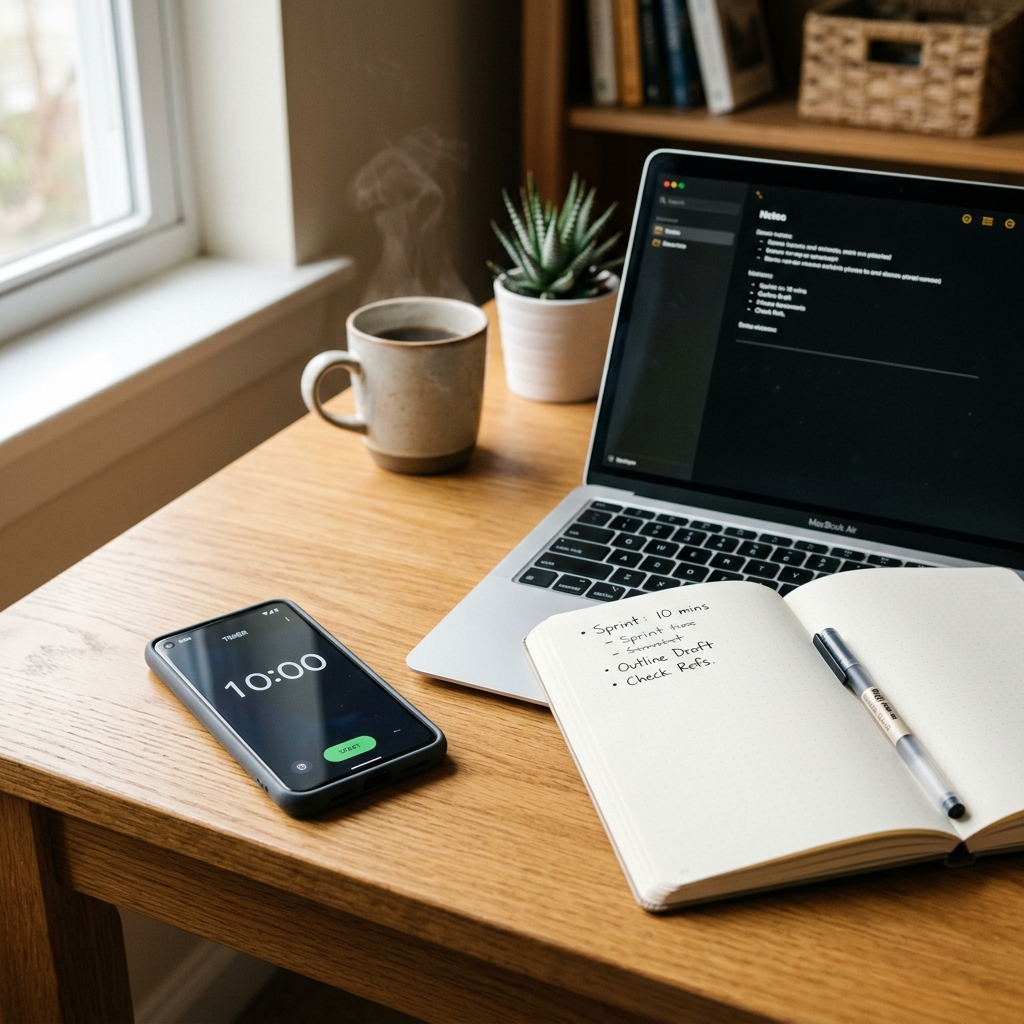
By Lauren Mitchell You know the feeling. The thing you’re supposed to be doing is right there. You’ve known about it for days, maybe weeks. You’ve told yourself you’ll “do it when I have more time,” “do it when I’m in the right headspace,” “do it after I finish this other thing first.” And somehow the day ends, and you didn’t do it, and you tell yourself tomorrow will be different. Here’s the lie you’re telling yourself. The lie is that you’re waiting for the right moment, the right energy, or the right mood. You’re not. You’re waiting for something else. And until you see what you’re actually waiting for, no productivity app, time-blocking technique, or morning routine will fix the problem. Procrastination isn’t about time. It’s about what you feel when you try to start. The Lie: “I’ll Do It When I Feel Ready” When you say “I’ll do it when I feel ready,” you’re outsourcing the start to a feeling that isn’t coming. The feeling you’re waiting for, confidence, clarity, motivation, calm, doesn’t show up before the work. It shows up during the work, and only sometimes. Most of the time, it doesn’t show up at all, and the work still gets done by people who stopped waiting. You are not lazy. You are not broken. You are stuck in a loop where your brain has decided the task is emotionally threatening, and starting it feels like walking toward something painful. That’s why you find every other possible thing to do. Not because the other things are important. Because they offer emotional relief. The browsing is relief. The email-checking is relief. The organizing your desk is relief. None of it is actually procrastination in the lazy sense. It’s avoidance of something you haven’t named yet. What You’re Actually Avoiding Procrastination almost always traces back to one of three emotional triggers. Pull on yours, and the stuckness starts to loosen. First: fear of judgment. You’re not avoiding the task. You’re avoiding the feeling of producing something someone might criticize, dismiss, or ignore. The task becomes loaded with every previous time you felt rejected or not good enough, and starting it means exposing yourself to that possibility again. Second: fear of commitment. Starting the task means committing to it, and some part of you isn’t sure you want to. Maybe you don’t actually want this job, this project, this relationship, and the procrastination is your body refusing to move toward something it doesn’t want. The question isn’t “why am I procrastinating?” It’s “do I actually want this?” Third: overwhelm. The task looks too big. You can’t see the first step. The moment you think about starting, your brain sees the mountain and freezes. You’re not avoiding the task. You’re avoiding the feeling of facing something you don’t think you can handle. For a deeper look at what happens when your nervous system gets stuck in that freeze response, see youre not lazy youre trapped. The 10-Minute Pattern Interrupt Now the fix. This is the single most effective technique for breaking procrastination I’ve ever found, and it works whether you’re dealing with fear, overwhelm, or just the low-grade resistance that sits on most tasks you don’t want to do. It takes ten minutes. No apps. No willpower. No morning routine required. You commit to doing the thing for ten minutes. That’s it. Ten minutes. You can stop when the timer goes off with no guilt. You can walk away. You can declare yourself done. The only rule is that for those ten minutes, you do the thing you’ve been avoiding, and nothing else. Why 10 Minutes Works When Hours Don’t The brain’s resistance is almost entirely to the size of the commitment, not the task itself. When you tell yourself you have to write for two hours, your brain calculates the cost and says no. When you tell yourself you have to work out for 45 minutes, same result. The number is too big. The prospect of sustained effort triggers the freeze. Ten minutes is small enough that the brain doesn’t protest. You can do anything for ten minutes. Even something you hate. So the commitment lands, the timer starts, and you begin. And here’s the secret: roughly 80 percent of the time, once you’ve been doing the task for ten minutes, you keep going. The resistance was never about the task. It was about the size of the commitment. Once you’re in, you’re in. How to Run the 10-Minute Interrupt in Real Life Set a timer. Physical timer, phone timer, whatever you have. Announce to yourself out loud: “I’m going to work on this for ten minutes. Then I can stop.” Start. No scrolling, no checking email, no looking at your phone, no letting yourself drift. Just the task. When the timer goes off, you get to make a real choice. Stop without guilt, or keep going. Most of the time, you’ll keep going, because you’re already past the resistance and into the work. If you stop, that’s fine. You just did ten minutes you wouldn’t have done otherwise, and you proved to your brain that starting this task isn’t the catastrophe it was making it out to be. The Repetition That Rewires the Pattern The 10-Minute Rule works once. But it works permanently if you run it enough times. Every time you do it, your brain registers one more piece of evidence that “starting this task is survivable.” After the first dozen times, the resistance starts to soften. After the first few months, it barely shows up. You’ve rewired the pattern that was keeping you stuck. This is the difference between a productivity trick and a long-term behavior change. Most productivity tricks work for a week and fade. The 10-Minute Rule doesn’t fade because you’re not relying on willpower. You’re building a track record. And every time you honor the ten minutes, you reinforce your identity as someone who follows through, even when you don’t feel like it.