By Rachel Bennett
There’s a reason motivation videos get millions of views and almost nobody’s life changes after watching them. Motivation isn’t a strategy. It’s a weather pattern. Some mornings you wake up feeling electric, ready to attack the day. Most mornings you don’t. And the gap between the 10 percent of days you feel motivated and the 90 percent you don’t is where most goals quietly die.
The people you envy (the ones who actually finish the book, build the business, lose the weight, learn the language) do not have more motivation than you. They have less. They’ve given up on motivation entirely. What they have instead is a system so boring, so small, and so repetitive that it works whether they feel like it or not.
Here’s the ugly truth about how consistency actually works, and the system that replaces motivation once you stop waiting for it.
Motivation Was Never Supposed to Be the Engine
The fitness industry sold you a lie. The self-help industry extended it. Every social media guru built their brand around it. The lie is: “feel the motivation, then do the work.” In reality, the sequence is reversed. You do the work first. Motivation shows up afterward, if at all. And most days it doesn’t show up, and the work still gets done.
Every elite performer in every field describes the same thing when you read their interviews closely. They don’t feel motivated most days. They feel the same lukewarm reluctance you feel. The difference is they stopped waiting for the feeling to arrive before they got started. They decoupled the action from the emotion.
The System: Shrink the Entry Point Until Resistance Disappears
Most consistency failures happen at the start. You don’t fail to write the novel. You fail to open the document. You don’t fail at working out. You fail to put on the shoes. The battle is won or lost in the first 60 seconds of whatever you’re trying to do, and motivation is the worst possible tool for winning that battle.
So you shrink the entry point. Instead of “write for an hour,” the commitment is “open the document.” Instead of “do a full workout,” the commitment is “put on the clothes.” Instead of “meditate for twenty minutes,” the commitment is “sit down and close your eyes for three breaths.”
This sounds too small to matter. It is not. The shrunken entry point bypasses the nervous system resistance that was blocking the larger action. Once you’re in the document, you usually keep typing. Once the workout clothes are on, you usually train. The small action does the heavy lifting the motivation was supposed to do.

Attach the Habit to Something You Already Do
The second pillar of the boring system is something behavior researchers call “habit stacking.” Instead of relying on memory or intention to trigger a new habit, you attach it to an existing one. After I pour my morning coffee, I open the document. After I brush my teeth at night, I write one sentence in my journal. After I sit down at my desk, I write one line of the book. The old habit becomes the alarm clock for the new one. For more on how environment design beats willpower, see youre not lazy youre trapped.
This removes the moment-of-decision that kills most new habits. You’re no longer deciding every morning whether to work on the book. The coffee makes the decision for you. The brushing makes the decision for you. By removing the decision, you remove the failure point.
Never Miss Twice
The most honest truth about consistency is that everyone misses days. You will miss workouts. You will miss writing sessions. You will miss the morning routine. The difference between the consistent people and the inconsistent ones is not that the consistent ones never miss. It’s that they have a hard rule about missing: never two days in a row.
Miss one day, and it’s a rest day. Miss two days in a row, and that’s the beginning of a new default. Three days becomes a week. A week becomes a month. The consistent person protects the second day at all costs. They don’t need to be perfect, but they treat two-day gaps as the red line that triggers immediate action, even if the action is the minimum version.
Track It So You Can’t Lie to Yourself
You will lie to yourself about how often you do the thing. You’ll remember the good weeks and forget the bad ones. You’ll tell yourself you’re doing great when you’ve missed half the days. The only cure is to track it in a way you can’t manipulate.
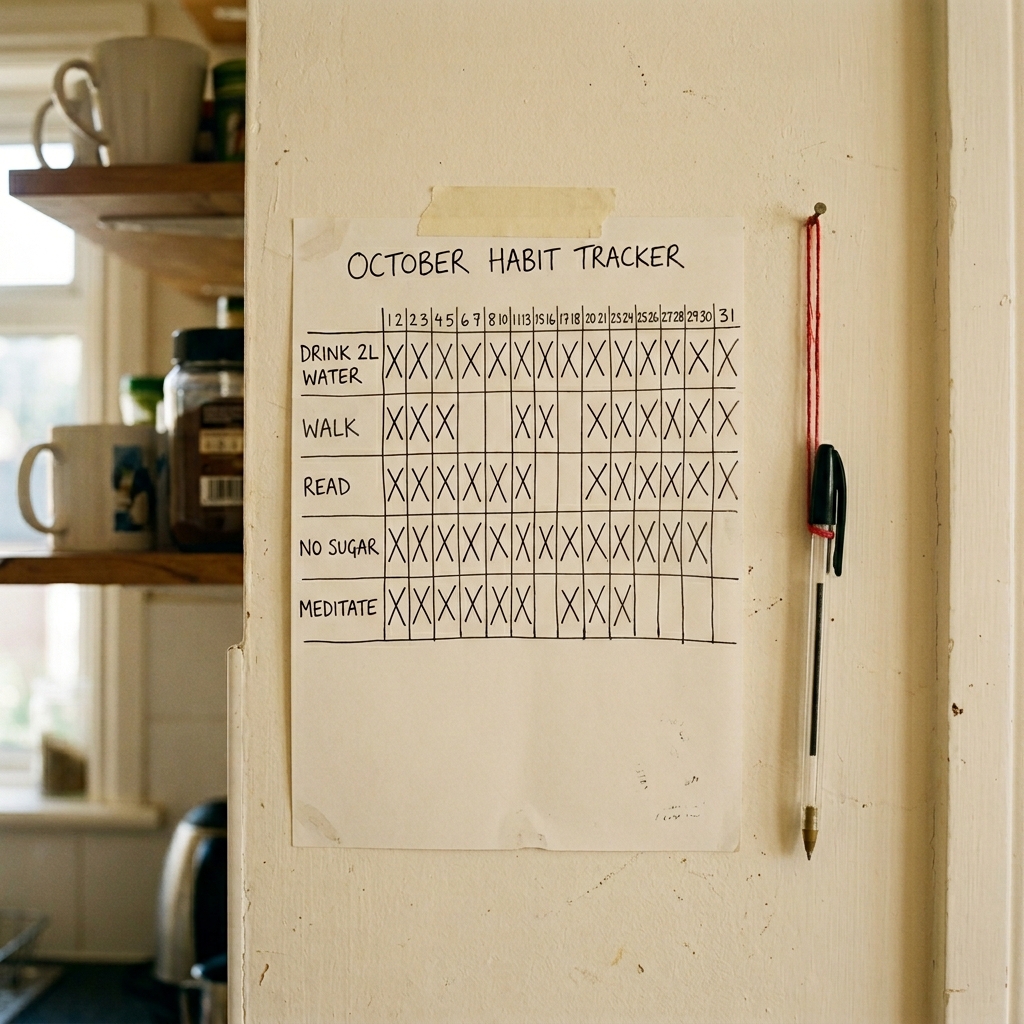
A simple calendar with an X on each day you did the thing is enough. A spreadsheet works. A paper habit tracker taped to the fridge works. The specific tool doesn’t matter. What matters is that the evidence is visible, honest, and impossible to ignore. Seeing the gaps in your tracker is uncomfortable. That discomfort is the feedback loop that keeps you consistent.
Detach Identity From Outcomes, Attach It to Actions
Here’s the mindset shift that makes the whole system stick. Stop defining yourself by what you’ve accomplished, and start defining yourself by what you do every day. I’m not a person who “will write a book.” I’m a person who writes every morning. I’m not a person “trying to get in shape.” I’m a person who trains three times a week. The outcome stops being the carrot. The identity becomes the reward. You get to be that person every single day you do the thing, regardless of whether the outcome has arrived yet. For more on how perfectionism disguises itself as high standards, see procrastination lie you keep telling yourself.
This is why consistent people seem unfazed by slow progress. They aren’t chasing the outcome. They’re already living as the person who takes the action. The outcome is a downstream consequence of who they’ve decided to be, and who they’re being is confirmed daily by the tracker on the fridge.

The Ugly Part Nobody Wants to Say Out Loud
The boring system works because it’s honest about what consistency actually feels like. It’s not dramatic. It’s not exciting. It’s not the fantasy the motivation industry sold you. Most days of showing up feel like nothing. You do the thing, you check the box, you go about your life. No rush, no transformation moment, no cinematic swell.
But six months in, you look up and you’ve written 80,000 words. You’ve dropped the weight. You’ve learned the language. You’ve built the business. None of it came from a motivated morning. All of it came from a system that didn’t care how you felt.
Your Move This Week
Pick one thing you’ve been trying to be consistent at. Shrink the entry point until it’s embarrassingly small. Attach it to an existing habit. Tell yourself the rule: never miss twice. Put a tracker somewhere you’ll see it every day. That’s the whole system. Tell me in the comments what you picked, or share this with the friend who’s still waiting for the motivation to come back.